(UPDATED with Bob Buckhorn response)
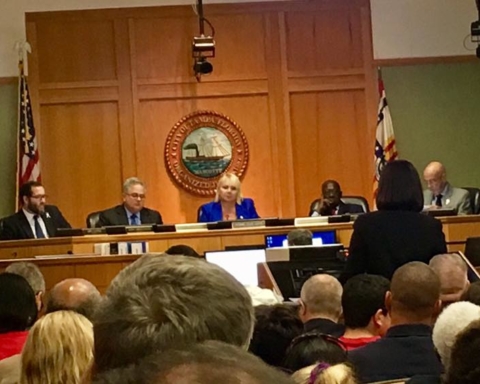
At last week’s Tampa City Council meeting, the tension between some members of the board and Mayor Bob Buckhorn was on full display for the public to witness. The mayor’s announcement that he had signed an executive order on a police civilian review board (CRB) six days in advance of a previously scheduled Council meeting with Police Chief Eric Ward was a catalyst, while the dispute about who can name the members of the CRB remains the central issue between the two bodies of local government.
After some Council members complained that they weren’t consulted ahead of his executive order announcement, Mayor Buckhorn countered by saying that Council members could have reached out to him in advance. However, at least one member of the board, Councilwoman Lisa Montelione, says she didn’t think that was possible.
The District 7 representative says that after she and Buckhorn were elected together back in 2011, they had regular meetings usually every quarter for the first year and a half, but then those quasi-regular meetings stopped rather suddenly. She believes that happened after she questioned Neighborhood Empowerment Director Jake Slater in a manner that she says “the mayor felt a little too aggressively, and the meetings stopped.”
“Every time I tried to make an appointment with him, he was not available,” she says. “So when he said that the Council should have ‘come to talk to me about this,’ I’m thinking, I tried making an appointment with you for months.”
Montelione said she and the mayor spoke at last week’s Hillsborough County Democratic Party’s Kennedy-King dinner. She says she was initially penciled in to meet with him this week, but his office called back to say that he would be out of town and has rescheduled for next week.
Mayor Buckhorn contacted SPB this afternoon from Tampa International Airport, where he was about to catch a flight to Houston. He didn’t deny at all the fact that he has not met with Monteleone since her questioning of Slate.
“I’m not going to have any of my staff member harangued or humiliated,” Buckhorn said. “They do a good job and they deserve to be treated accordingly. That sort of is the baseline for me.”
Buckhorn says that his track record shows that he’s more than willing to meet up with Council members, and he’s sorry if Montelione has a different perspective. But he also didn’t forget what happened with Slater.
“They say one thing when the TV cameras are on, and apologize when the cameras are off, and I’m just not going to tolerate that. They’re (his staff) good folks, and they deserve to be treated with respect.”
That will happen after the Council’s scheduled workshop this Thursday to discuss a civilian review board. City Attorney Julia Mandell has declared that only the mayor has such powers. City Council’s own attorney, Marty Shelby, disagrees.
“I think on all sides, we’ve clearly not done a good job of communicating with each other,” concedes Councilman Harry Cohen.
Cohen said he hasn’t requested a meeting with the mayor of late, but says that in the past, Buckhorn has always been accommodating to him in making himself available.
Linda Saul-Sena served on and off the Tampa City Council from the late 1980s until 2010, when she lost a race for a Hillsborough County Commission seat. She’s not an attorney, but does believe that Council has more power than some members may think they have.
“I believe that the mayor has forgotten his eight years as a City Council member because if he thought back clearly, he would remember that the Council, I believe, has the power to set up review boards like this,” though Buckhorn has said that’s not the case, a distinction he has said he learned when he served on the board (with Saul-Sena) from 1995-2003.
“I believe that the mayor is misinterpreting Council’s boundaries,” says Saul-Sena. “I believe that the Council absolutely has the authority to set this up.”
Cohen said last week that it was “high time” for the mayor to begin consulting with Council members on the issue. However, he says he’s not as concerned as some of his colleagues are about who gets to pick the members of the CRB.
“What matters is whether any board is going to be effective and be able to have an impact, and the only way is if it’s going to have an impact is if the mayor is receptive to listening to it and cooperating with it,” says Cohen. “Because at the end of the day, regardless of who creates the board, the board has to advise whoever is in control of the Police Department, and under the charter, that is the mayor. So the person who is advising has to be willing to listen to it and engage with it, so that’s why I think you have to have some cooperation or you’re really not going to get anywhere.”
Meanwhile, newly hired independent attorney Gwynne Young is scheduled to make her decision on the conflict of interest with the City Attorney’s office sometime later today. The Council is scheduled to hold a workshop this Thursday on its own proposal to name the majority of members to the civilian review board.