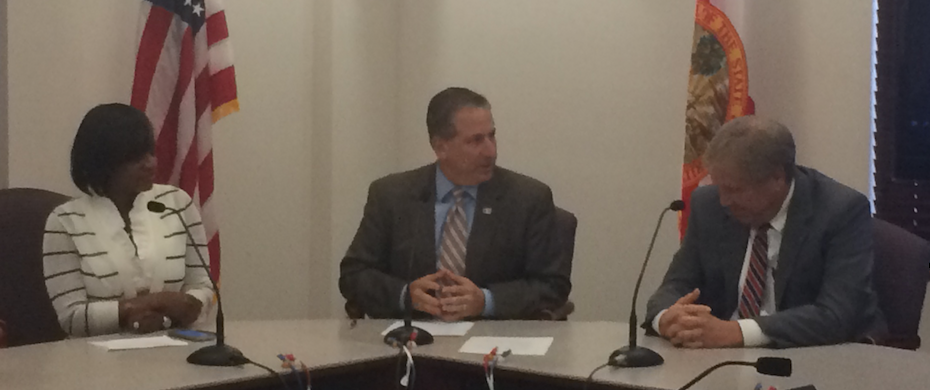
Four top city officials returned from Cuba over the weekend following a two-day fact-finding trip to the island nation. St. Pete Mayor Rick Kriseman, deputy mayor Kanika Tomalin, chief of staff Kevin King and City Council chair Charlie Gerdes departed for Cuba Thursday and returned Saturday, a day earlier than expected, anticipating possible inclement weather due to Tropical Storm Erika.
During a press conference unveiling the group’s findings, Gerdes issued a several minute-long passionate recollection of his short visit to Cuba.
“If we continue to focus on the differences in governance, there are many, many other more important human dignity issues that are being ignored because everyone is focusing on this one difference,” Gerdes said.
While President Barack Obama continues taking steps to normalize relations with Cuba, there are still many barriers in place prohibiting Cuba from trading with the United States or benefitting from other diplomatic ties.
Kriseman told reporters and a handful of members of the public and city staff one of the biggest challenges facing Cuba as a result of the decades-long embargo includes the nation’s lack of access to credit.
“Having access to credit is really quite important,” Kriseman said.
He explained how St. Pete funds major infrastructure projects and various community improvement through bonds. Doing that requires access to credit.
As a result, stepping into Cuba is like stepping into a time machine and being catapulted back in history. Cars are from the ’50s. Buildings are in disrepair. Air conditioning is limited.
But Gerdes noted an air of equality throughout the nation. Cuban leaders are often criticized as being repressive and leaving citizens in deplorable conditions. But Gerdes noted that government buildings were in just as much disrepair as other buildings and homes.
“It’s not the government pouring money into its own buildings and taking care of itself while they ignore the people,” he said, calling it uniformed deterioration. “The haves and the have-nots like you see in other impoverished countries where you see mansions up on the hill and cardboard box houses, that’s not what you see in Cuba.”
One of the things Gerdes said he took away from top leaders in Cuba was the nation’s impressive literacy rate – 100 percent of Cuban children know how to read and write.
And he said the only nation to send more doctors to Africa during the Ebola crisis was Cuba. Cuban doctors worked hand in hand with American physicians.
And he said the Coast Guard works with the Cuban military on drug crackdowns. Public safety, Gerdes said, was also quite good.
“This was one of the few places in the world where Marines could freely walk with their uniforms on and not worry about repercussions,” referring to American soldiers working at the U.S. Embassy recently opened in Cuba.
But the group of St. Pete leaders didn’t just go to Cuba to check out how Cubans lived and whether things were really that bad for Cuban citizens. They also went hoping to build relationships with the nation as the United States becomes increasingly close to normalized relations.
Kriseman made a very direct request to officials, beseeching them to consider a Cuban consulate office in St. Pete. Kriseman’s argument – there are 80,000 Cubans living in the Tampa Bay area and a million more within a four-hour drive.
Most of those living in Tampa Bay are likely living in Tampa, where Cuban history is still readily embraced through preservation of cigar factories and, of course, Ybor City.
Kriseman also highlighted similarities between St. Pete and Cuba, particularly Havana. He said both are facing mounting fears concerning sea level rise and climate change.
Cuba also shares a rich arts environment. Tomalin told reporters there were wall murals similar to ones you might see throughout downtown St. Pete. Street musicians serenade people at restaurants, folk art dots cities and fine art lines the walls of an art museum.
“Art is a definitive element of Cuba’s culture,” Tomalin said.
Kriseman didn’t return to his city with any signed deals, but said he felt confident in the relationships fostered during the brief trip. He plans to continue investigating and pursuing a possible Cuban consulate in St. Pete.