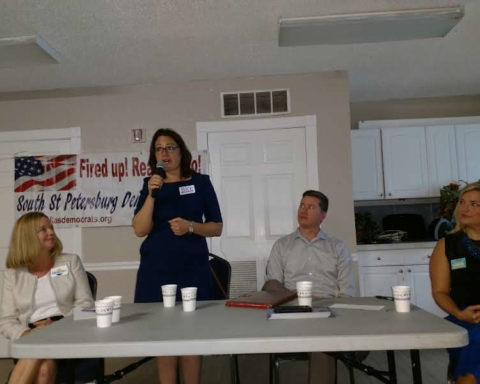
Five candidates for St. Pete City Council debated various political policies during a two-hour debate hosted by the group Fight for $15 during a candidate forum Tuesday night in Child’s Park.
District 7 candidates Will Newton, Lisa Wheeler-Brown, Aaron Sharp, Sheila Scott-Griffin and Lewis Stephens answered a number of questions about problems most specific to their district, which includes two of the city’s poorest neighborhoods – Midtown and Child’s Park.
While the candidates each did a fantastic job of voicing their opinions and threw out a number of viable ideas on how to improve living wage standards in the city, the debate was mostly a farce.
First of all, the majority of the questions involved topics City Council members have little or no control over – minimum wage. It’s an important topic and a controversy spreading across the nation like wildfire. As several of the candidates pointed out, no person who works full-time should have to worry about how they’re going to keep a roof over their head and food on their table.
Each of the five candidates all agreed with the notion that workers should have access to livable wages, though each seemed to have their own ideas on how to get there.
Lisa Wheeler-Brown, who is leading the pack in fundraising but sits at third in a poll commissioned by SaintPetersblog, pointed to a wage theft ordinance pushed by Councilmember Darden Rice. She said something similar could be done for Certified Nursing Assistants who not only bring in abysmal salaries, but who are also saddled with high patient to CNA ratios.
Will Newton, incumbent Wengay Newton’s brother and a longtime collective bargainer for fire fighters, suggested groups making less than a living wage organize and fight back.
Scott-Griffin looked to the newly created Community Redevelopment Area that will pump millions of dollars into the community eventually to make livable wages a mandate in city contracts. The city has already passed a requirement that city contracts hire a certain percentage of hard-to-hire workers.
Aaron Sharpe, president of the Pasadena Bear Creek Neighborhood Association whose campaign platform is “opportunity,” emphasized incentivizing businesses so they have more money to work with in order to pay higher wages. It’s something he said they probably want to do anyway.
And he said that multiple times. Why? Because the same question was asked in a number of ways.
What will you do to support a living wage? What will you do to support a living wage for healthcare workers? What will you do to support a living wage for childcare providers?
Catch my drift? How many ways can you ask the same question and expect a different answer? One question asked of council candidates: what will you do immediately?
The answer, of course, was that nothing is immediate.
The thing here is, this is a field of candidates obviously leaning toward more progressive policies. Of course they support a livable wage and of course they are going to take whatever minimal steps they can to ensure residents in their community aren’t digging in the trash for food or taking to the streets to make a living as a criminal.
Duh, duh and duh.
Mad kudos go out to all five candidates who somehow managed to add a little something new each time the question was asked. Wheeler-Brown added an anecdote about having previously worked as a CNA. She said she only lasted a year because it was a ton of work for really crappy pay – my words, not hers.
But even through her endearing anecdote, the bottom line was the same – there’s not a whole lot City Council can do thanks to the lovely folks in Tallahassee, who through legislation have said they can’t. It’s literally against the law.
The living wage topic was a dead horse and it was beaten. For like, an hour. I’m not saying this group isn’t fighting the good fight. Agree with the exact number or not; agree with increasing minimum wage at all even, there is little debate that people should be able to take care of themselves and their families. Take the debate to Tallahassee, where something can actually be done.
And that’s not even the worst part. Organizers of the event appeared to go to great lengths to make the questions look like they were posed by concerned citizens.
They weren’t.
Questions were emailed to each of the five candidates prior to the debate. Those questions were read nearly verbatim during the forum, but not by the people who presumably wrote them.
Maybe some of the people who read the questions had actually posed them, but that’s debatable. Individuals were called upon to read each question and it sounded to the unknowing ear as if those people had taken pains to formulate the questions.
It was sneaky. It was tricky. And above all else, it was unnecessary.
My guess is the people who read the questions were hand picked by Fight for $15 organizers to personally represent the issues. A healthcare worker. A child care provider. Etcetera, etcetera, etcetera.
Those who read my more opinionated columns regularly or who listen to me on my talk show on WMNF Community radio or who follow me on Facebook or Twitter probably know the minimum wage issue is likely to be on my list of no-brainers. I’m not digging on the goal these fine, dedicated and passionate young people seek.
I’m simply saying, don’t bamboozle people in the process. And don’t drag out an issue in a City Council debate forum that the candidates have little or no control over from the dais.
Criticism aside, there were a few take-aways relevant to City Council. Candidates weighed in on the issue of police overreach in District 7. All five candidates suggested better and open communication with officers and Police Chief Anthony Holloway.
Sharpe suggested that Holloway’s newish “Park, Walk, Talk” policy is great, but once a week just won’t cut it. Scott-Griffin, in one of her amazingly passionate answers, said it’s a two-way street between both the community and police in which an integrated approach is necessary. Wheeler-Brown reminded residents there is a process in place to file complaints against overbearing cops.
That was a great question. It’s a crucial issue in a unique community.
Another question asked how candidates would use funds derived from the new CRA. The answer yielded new information critical for residents to embrace – the money isn’t going to appear overnight. But plans for the money when it does were enlightening – youth programs, said Lewis; back off gentrification, fired Newton.
This was also a great question. This community, perhaps more than any other, has a special set of needs. They need affordable housing (that was also addressed.) They need economic development. They need jobs and jobs training. They need childcare. They need safe neighborhoods.
The Fight for $15 movement addresses many of those topics, but it was hashed out in too much detail in an entirely wrong forum.
That’s all I’m saying.