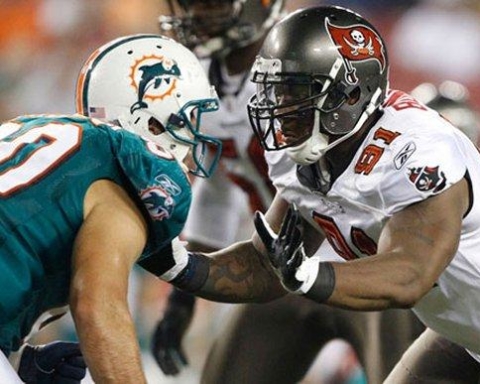
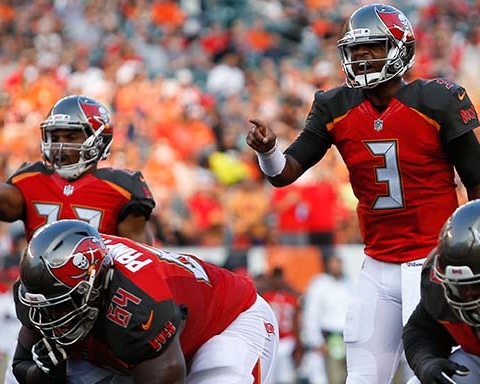
On Wednesday, this reporter wrote about the new slogan being pushed by the Tampa Bay Buccaneers, “Siege the Day.” In that report I pointed out the slogan doesn’t exactly send a positive message to anyone with a remedial high school education or the ability to Google a definition.
Siege means “a prolonged period of misfortune” in some uses. And even under the more popular use of the word, referring to some form of occupation, it still doesn’t really make sense.
But I overlooked one very key problem with the play on “Seize the Day.” Siege is not a verb, it’s a noun. The Tampa Tribune’s education beat reporter, Erin Koukournis caught it, though. In a report posted the same day as my own, Koukournis lays out analysis from several Hillsborough County teachers looking at the issue.
“It’s a play on words,” Clair-Mel Elementary School reading resource teacher Keri Kozerski told the Tribune. She reportedly saw the slogan on a television commercial Wednesday morning. “I understand it, but it’s not a verb and it doesn’t make sense. They may want to rethink that and use a verb.”
The most common use of the word “siege” is to lay siege where “lay” is the verb and “siege” is the noun.
The Bucs’ chief marketing officer, Brian Killingsworth, explained the marketing strategy to The Tampa Tribune.
“Siege is the Bucs way to seize the day,” he said, noting the use of the word as pirate lingo. He added it creates a “call of action and to sound more aggressive in how we take the day.”
Note there is a bit of a grammatical error in Killingsworth’s quote. Notice that missing apostrophe in “Bucs”? Now, that could have been a typo by the person writing the quote down, which would be especially true if his comments were delivered in person. However, most press inquiries of this nature are handled via email, which leaves this writer with the impression that it was not Koukournis’ blunder.
Plus, it’s not the first time there’s been grammatical errors in Buccaneer propaganda. Remember “It’s a Bucs Life?” The “life” in this quip belongs to the Bucs. Thus, another missing apostrophe
But, as the Tribune piece points out, advertisers aren’t always too concerned with grammar.
“You have to keep in mind that advertising is the venue that brought you doughnuts spelled d-o-n-u-t-s, drive-through spelled t-h-r-u,” Sam Bradley, director of the Zimmerman School of Advertising & Mass Communications at the University of South Florida told The Tampa Tribune. “Advertising is about clever, memorable communication. Nobody wrote that intending it to be grammatically correct.”