Gwynne Young, the independent attorney hired by the City of Tampa’s Legal Department for $10,000 to render an opinion on whether City Attorney Julia Mandell has a conflict of interest in the controversy over a civilian review board, has determined that Mandell has no conflict.
“The fact that constituents of the organization have internal disagreements does not change the fact that the lawyer’s only client is the organization,” Gwynne writes in her eight-page opinion made public on Tuesday. “The lawyer’s duty of professional loyalty is owed only to the organization, not to any individual. The conflicts of interest rules are not implicated should an internal dispute occur.” (our emphasis).
The overlying question has been who has the right to name the members of the newly announced police civilian review board. Mayor Bob Buckhorn announced the formation of such a board on August 28 in an executive order, where he gave himself the power to name seven of the nine-member board, as well as the two alternates.
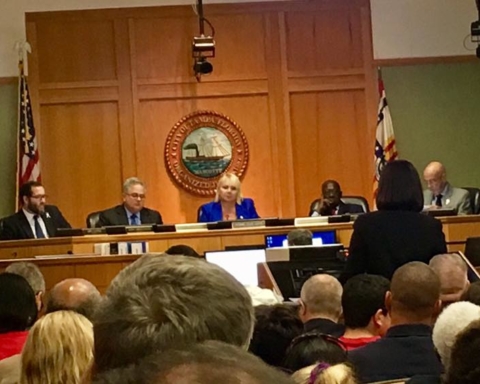
That has angered members of the City Council who say the mayor preempted them with his executive order. They have voted on a proposal (to be discussed this Thursday) that would give them the power to name seven of the 11-member board.
The City Council’s attorney, Marty Shelby, says the Council has the power to name such a board. City Attorney Mandell has determined that they do not, only the mayor does. With some council members questioning whether Mandell is speaking for the mayor or the entire city government, Mandell said she would hire an outside attorney to rule on whether she had a conflict of interest.
Gwynne, an attorney with the Tampa law firm of Carlton Fields Jorden Burt and a former president of the Florida Bar, writes at the onset of her opinion that she was charged with answering three questions presented to her from Julia Mandell last week. They were:
1) Under the Charter of the City of Tampa (“Charter”), and the Rules Regulating The Florida Bar, who is the City Attorney’s client?
2) Under the Charter, and the Rules Regulating The Florida Bar, who is the City Council Attorney’s client?
3) Is the benefit of qualified immunity potentially available if a government employee relies upon the opinion of either the City Attorney or the City Council Attorney?
Gwynne also writes that she and her legal team “assumed” that the Florida Bar, the American Bar Association, and the courts in Florida have never rendered a legal opinion or a decision that specifically resolves the questions posed to us, and thus, “our opinion and analysis is limited to our legal experience and research.” She also notes that she interviewed Mandell and Shelby to gain their insights.
To answer the first question, Gwynne determines that, “in sum, pursuant to the Charter, and the Rules Regulating the Florida Bar, it is our opinion that the “client” of the City Attorney is the Tampa city government and organization.”
Regarding the second question on the City Council Attorney, Gwynne notes that the Charter prohibits the City Council Attorney from filing litigation on behalf of the council, the mayor, or any city department without approval of the city attorney. Also that the City Council attorney cannot issue legal opinions, as that is the role of the City Attorney, and that the City Council attorney’s actions cannot be construed to reflect the official legal position of the city.
Her conclusion?
“It is our opinion that the “client” of the City Council attorney is the City Council as an organization body, but only in an advisory capacity with a limited scope of representation (emphasis ours) that is specifically designed not to interfere with the City Attorney’s role as lawyer to the entire government organization.”
On the third question, Gwynne writes about he issue of “qualified immunity,” an issue that Mandell emphasized last week in talking to the City Council.
The conclusion? Here comes some big-time legalese.
“It is therefore our opinion that the benefit of qualified immunity is likely available as a defense to a government employee when relying on either the opinion of the City Attorney or, in the case of the City Council, the City Council Attorney, that outlines that the employee is acting within the scope of their authority under clearly established law. Should a difference of opinion occur, however, reliance upon the City Attorney’s opinion would likely afford a defendant a stronger argument to make to a judge that a qualified immunity defense is appropriate, especially since the obligation of “good faith” would imply compliance with the City’s Charter.”
However, Laila Abdelaziz, an official with the Council on American-Islamic Relations (CAIR) and also a member with Tampa for Justice, issued a statement this afternoon where she says that, “It is clear why the City Attorney submitted a question to Ms. Young about qualified immunity and that the City Attorney expected that Ms. Young would say that if the City Council listened to the City Council Attorney instead of the City Attorney, they would lose their qualified immunity but, in fact, Ms. Young’s opinion says the complete opposite.”
She references Young’s opinion that the “benefit of qualified immunity is likely available as a defense to a government employee when relying on either the opinion of the City Attorney, or, in the case of the City Council, that outlines that the employee is acting within the scope of their authority under clearly established law.”
“Tampa for Justice urges our City Council members to enact their legislative powers and establish a civilian review board with subpeona power,” Abdelaziz writes.
The City Council is scheduled to workshop discussions on both the city charter and the council’s own citizens review board this Thursday at City Hall at 9 a.m. Calls to City Council Chairman Frank Reddick went unreturned by the time this story was posted.
SPB reached out to City Council Attorney Marty Shelby. He said it would be inappropriate to comment before speaking to his clients (the Council) at this time.