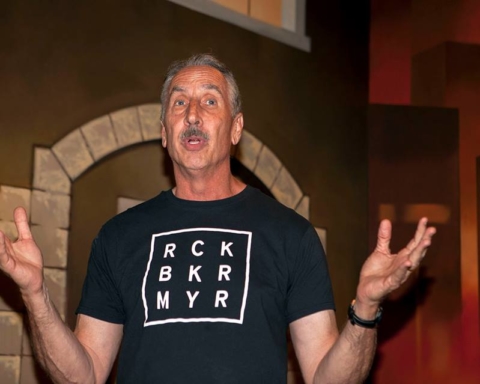
Surveying the crowd before the beginning of his Wednesday evening speech about Jeb Bush at the Main Library in Downtown Jacksonville, Matthew Corrigan surveyed the crowd of 20 or so political junkies and brought up former Florida Gov. Reubin Askew.
When Askew got to New Hampshire to give the first speech of his doomed presidential bid in 1984, there were three people there to see him. This led Corrigan to observe that “anytime there are more than three people in the room for a speech, I’m happy.”
Corrigan had a decent turnout to discuss his book, Conservative Hurricane. And he had a great subject: the rise and continued rise of Jeb Bush, which he painted in familiar quasi-dynastic tones.
“1984 was the last time the Republican Party won a presidential race without a Bush on top of the ticket,” Corrigan said, adding that “1972 was the last time without a Bush on the ticket at all.”
Could 2016 be the year of Jeb? Corrigan does not rule it out, citing the emergence of the Right to Rise super PAC, which has already scheduled at least one $100K-a-plate fundraiser.
“You don’t raise that kind of money without ‘Bush’ in the name.”
Despite this, Jeb has not gotten the seeming coronation that Hillary Clinton has gotten on the other side. A “mixed reaction” greeted the former Florida governor in New Hampshire, as people are “looking for a fresh face.”
Those who want a presidential candidate who “got things done” as a governor, added Corrigan, will probably want to give the familiar face a fresh look. Bush “proposed an agenda, got his agenda passed, and followed up,” Corrigan said, “transforming the office” of governor.
Part of his transformational ability came from a transformation in state government. In the wake of Reconstruction, a “whole new state Constitution set a precedent for weak government and limited executive authority,” related Corrigan. Legislatures could “wait out the governor.” This started to change in 1968, when governors were allowed two terms after a long “one and done” period.
When Bush came in, term limits had been imposed on the Legislature, which gave him one advantage. Another advantage was that he had a unified Republican government. Unlike some chief executives with those advantages, Bush set an ambitious agenda that resonated with people and lawmakers alike.
“He had his way with the Legislature six of the eight years he was in office,” Corrigan observed.
Jeb’s rise merits analysis in the context of the evolution of the post-World War II conservative movement, which saw the right ascendant and wanting to put its stamp on American politics.
Eisenhower was not conservative enough for them; Goldwater was, but his principal utility was setting the table for Ronald Reagan. Reagan, of course, chose G.H.W. Bush as his veep, which was significant. A Connecticut Yankee in the Lone Star State, Bush was never conservative enough for Texans; as Reagan’s second-in-command, any ideological qualms were eventually overcome.
Corrigan glossed over the historically interesting Bush 41 term, and fast forwarded to the 1994 emergence of Jeb Bush as a self-described “headbanging conservative,” the “Ted Cruz of his day,” who famously said, when asked what he would do for African Americans: “probably nothing.”
1998 saw Jeb moderate his presentation, Corrigan continued, before launching on eight ambitious years of conservative governance that were designed to create a time when government buildings were emptied, and became “silent monuments” to a time when government attempted more than it had the right to do. Jeb Bush pushed an agenda of privatization that had “mixed results,” especially related to human resources and prisons. He curtailed affirmative action, and pushed for the Castle Doctrine, and so many other things besides that laid the groundwork for the Florida of today.
Despite this, he has some positions that are out of step with much of the current conservative movement. One such: his immigration position, a “reform” position designed to provide immigrants with a more “welcoming atmosphere.” This cosmopolitan approach was burnished by Jeb’s own family history, as well as by settling in Miami, “the most immigrant friendly city in the country,” which “shaped his view on immigration.” Jeb refers to himself as “bicultural,” a designation which may give many conservatives total pause.
Jeb, related Corrigan, has to run a gauntlet of younger conservatives more like the 1994 “headbanging conservative” version of himself in the primary. If “Jeb can make it through the process,” he will face Hillary Clinton, most likely, which reminded him of George Mason‘s premonition about the dangers of the “elective monarchy.”
Hillary will want to win Florida, for more reasons than just the electoral calculus. Bill Clinton, claimed Corrigan, “never got over losing Florida in 1992.”
The country has changed in recent years, however. Despite Jeb being the “most conservative” of the Bushes who reached national prominence, he is still seen as the “center-right alternative to the Tea Party/conservative base.”
Ironically, for Jeb, governing might be the easy part. Corrigan believes that if he wins, he will carry a Republican Senate with him. The hard part: making the sale to a party that might have moved on already from Jeb’s brand of conservatism, which owes more to the Reagan Revolution than to the pyrotechnics of Ted Cruz.