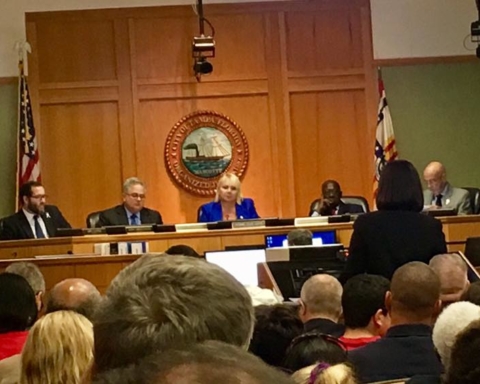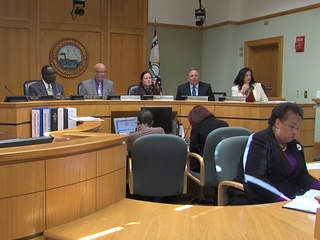
The rocky relations between Tampa Mayor Bob Buckhorn and the City Council deteriorated to a new low this morning at City Hall, after City Council Chair Frank Reddick angrily disagreed with City Attorney Julia Mandell’s choice of an attorney to review if her office has a conflict of interest regarding who she represents at City Hall. The fiery confrontation between the two ended with Reddick muttering, “I’m not going to be a butt-kisser to no one.”
The larger issue regards the continuing divide between the Council and the mayor regarding who has the power to select who will serve on the city’s police civilian review board. Last month Buckhorn announced an executive order creating such an agency, which would review cases and issues related to the Tampa Police Department and to provide feedback and recommendations to the chief of police. The executive order would allow him to name nine of the 11-member board, something the majority of the Council opposes, with a counterproposal offered by Reddick that would give the Council the power to name seven of those eleven members.
Mandell says the city’s charter gives the mayor the exclusive power to name the civilian board members. But City Council attorney Marty Shelby has challenged that assertion, leading to the question of who serves as the client of the city attorney and when can a conflict of interest occur. That prompted Mandell to say she would hire an attorney outside of city government to make that determination.
Mandell announced today that she has hired Gwynne Young from the Tampa law firm of Carlton Fields Jorden Burt to make a determination on what constitutes a conflict of interest by next Monday. Young is the past president of the Florida Bar, and has not come before the Council for years, Mandell said. Young will be paid $10,000, with these funds coming from the City Attorney’s office.
But Shelby opposes her selection, saying today that Mandell said a reason for hiring her was that she knew Tampa politics. “My opinion is that City Council would be be better served if this was not a political issue,” Shelby said. “I mean no disrespect, but her comment to me gave cause for concern.” He suggested Mandell instead get a ruling from the Florida Bar instead.
But Mandell said her comment was “misconstrued,” and that Shelby hadn’t offered another attorney’s name to consider. But Reddick questioned Young’s independence, and asked Mandell if she knew if Young had made any campaign contributions to the mayor or members of council. Mandell said she hadn’t checked that. Ultimately, as Mandell slinked away from the dais, Reddick said, “I’m not going to butt-kiss anyone.”
Mandell had informed the council that she wanted Young to assess an issue bigger than the specific dispute regarding who has the power to name members to the civilian review board. She said she wants Young to decide who serves as a client for the city attorney, and when can a conflict of interest occurs. She also wants the attorney to determine who is the client for the City Council attorney and when can a conflict occur there.
“It is to provide City Council, the employees of the city that I worked with regularly over the last 11 years, the administration including the mayor, with qualified immunity,” said Mandell. “That is the primary responsibility of every governmental lawyer. And that is an issue that needs to be dealt with and resolved, because if it’s not, where we find ourselves litigating this particular issue…and it’s ultimately that this council was acting outside of the scope of their authority, and ultimately personally liable. That is a huge undertaking as a lawyer to make sure that that doesn’t occur, and we advise you properly. That is not an issue the Florida Bar can look at.”
Councilwoman Montelione told Mandell that the directive was broader than the issue at hand. “This might dilute the information that we’re actually looking for,” she said.
But Mandell said the conflict of interest couldn’t be limited to this particular issue. “This isn’t a conflict under city of Tampa ethics rules….this is personal to attorneys. We have an obligation under Florida Bar rules if a conflict exists, and then to advise our clients as to what the remedies were.”
City Councilman Charlie Miranda has been the one consistent voice on Council who has backed Mayor Buckhorn fully on the dispute, and said the issue was “petty stuff, kid stuff.” He said the issue was actually about jealousy. “It’s about not being able to do whatever the hell you want to do, where you think you want to go somewhere that you can’t.” He added that this problem really began when the city charter was amended by referendum in 2008 opted to vote to hire their own attorney. “We’re spending $10,000 …and people out there are not eating, sleeping in the streets. I don’t feel good about it.”
“I really take offense that I am jealous of the mayor,” said Monteliione, adding that the conversation had gotten completely out of hand. Montelione then brought up an earlier incident involving the Tampa Fire Department that she was involved with, criticizing how she learned about a resolution to the issue via a memo distributed to the Council from Buckhorn’s chief-of-staff Dennis Rogero, who opted not to even speak to the Council in person to report on the mayor’s decision on the matter.
And she went on to say that the entire council has respect for the Tampa Police Department, after that belief was questioned earlier this week by Police Benevolent Association President Vincent Gericitano. He made a comment this week that he was disgusted with council members pushing for a review board, adding to the toxicity of the debate. Gericitano called the creation of a board “an insult” to the police department and those who conduct investigations of possible officer wrongdoing.
“It looks like a war between the mayor and the council, the council and the police,” said Councilman Guido Maniscalco, who blamed the mayor for announcing the executive order before meeting with council members. “It looks like a mess.”
Councilwoman Yolie Capin said that Mayor Buckhorn’s preemptive mode in signing the executive order in creating the civilian review board has “tainted” the issue.” That’s when it went off track,” she added.
“I thought the mayor was disrespectful of council and what council was trying to do,” said Councilman Harry Cohen. “That’s primarily why this has disintegrated the way it has,” he said, adding that it was “high time” for the mayor to begin consulting with council members on the issue.
Newly hired independent attorney Gwynne Young is scheduled to make her decision regarding the conflict of interest with the City Attorney’s office on Monday. The Council is scheduled to hold a workshop next Thursday on its own proposal to name the majority of members to the civilian review board.