A St. Pete nonprofit that serves underprivileged youth and others in the Midtown community may be breaking an Internal Revenue Code and be at risk of IRS sanctions.
Advantage Village Academy offered space free of charge to St. Pete City Council candidate Lisa Wheeler-Brown to use periodically as office space for her campaign. Under any definition, that is considered an in-kind contribution. But there’s a problem. Nonprofit 501(c)(3) organizations are explicitly prohibited from contributing, in-kind or otherwise, to political campaigns.
“Under the Internal Revenue Code, all section 501(c)(3) organizations are absolutely prohibited from directly or indirectly participating in, or intervening in, any political campaign on behalf of (or in opposition to) any candidate for elective public office. Contributions to political campaign funds or public statements of position (verbal or written) made on behalf of the organization in favor of or in opposition to any candidate for public office clearly violate the prohibition against political campaign activity. Violating this prohibition may result in denial or revocation of tax-exempt status and the imposition of certain excise taxes,” reads a statute on the IRS website.
Advantage Village Academy was listed seven times in amended reports filed Wednesday morning as an in-kind contributor of office space. Four of those occasions were valued at $40 each and the other three $30.
With that information in mind it is pretty cut and dry — Advantage Village Academy is a nonprofit organization and it offered in-kind services to a political campaign. It broke the IRS code.
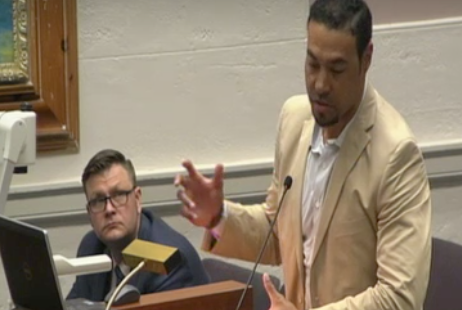
But it gets complicated. Toriano Parker, head of Advantage Village Academy, said Wheeler-Brown’s campaign incorrectly listed his nonprofit as the contributor. Instead, he said, the campaign finance reports should have listed him as an individual.
The office space used for free by Wheeler-Brown’s campaign was located (the group has since moved) in the same space as Advantage Village Academy. The building is owned by the St. Pete Housing Authority. But Parker claims he paid the rent for the property out of his own pocket, thus justifying why the in-kind contribution should be in his name.
If he’s paying the rent, should he have individual control over who gets to use the space? That becomes the question.
As a result of the controversy, the Wheeler-Brown campaign filed yet another amendment to its campaign finance reports. This time, references to Advantage Village Academy were changed to Parker Financial Services, a private entity not bound by IRS rules.
The issue has ventured into what may be a gray area. On one hand, Wheeler-Brown’s campaign was allowed to use space in the same building where a nonprofit organization operated. Parker was leasing the building for them. By that reasoning, it seems he still may have broken the IRS code. However, if it is Parker’s name on the checks and not Advantage Village Academy he may have sound argument to set the two apart as mutually exclusive.
Either way, the issue is further thrusting Wheeler-Brown’s campaign into the spotlight while also threatening a valued nonprofit in the community she seeks to serve.
Wheeler-Brown’s campaign was forced to file updated reports after it was uncovered that she had failed to list the free office space in campaign documents.