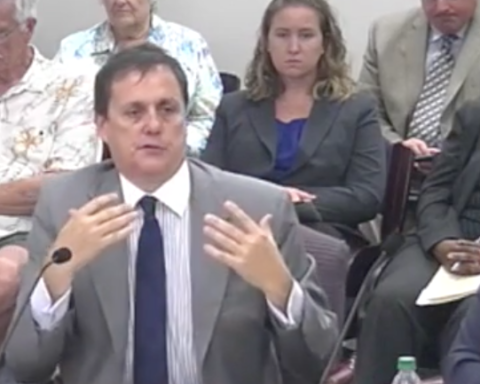
Florida Department of Environmental Protection Secretary Jon Steverson told a Senate panel this week he wants to cut and sell more trees from state parks — and do it faster.
Citing other states that have increased revenue from timber sales on state land, Steverson told senators he is working to make Florida’s state parks financially self-sustaining.
“I want to do it better, I want to do it faster, I want to do it as quickly as I possibly can,” he said. He added that generating more revenue will benefit taxpayers, park visitors and the environment.
Appointed by Gov. Rick Scott in December, the presentation was some of Steverson’s first public remarks since becoming DEP secretary. Steverson, who still faces Senate confirmation, had served 2-1/2 years as executive director of the Northwest Florida Water Management District.
On Tuesday, Steverson sounded almost breathless at times during a presentation on state land management as he used terminology that contrasted from typical park descriptions.
House Speaker Steve Crisafulli says the state should focus on land management rather than buying land following voter approval of Amendment 1, the water and land conservation funding initiative.
However, some environmentalists still are sore about DEP’s efforts in recent years to build RV campgrounds in state parks to boost park visitation and revenues.
Steverson described himself to the Senate Appropriations Committee on General Government as “hard-headed.” He said he can be “a bit stubborn” but added that he also is committed to focusing the department on land management.
State parks, he said, now are about 77 percent “self-sustaining” and his goal is to make park revenues exceed costs.
“I want to maximize value for the taxpayer — but also for the environment,” he said. “And I believe we can reduce that burden for the taxpayer.”
He said he is going to do that through “implementation of optimization planning.” And he said he wants to instill a “structured, repeatable, transparent approach” to decision-making.
He referred to Topsail Hill, a beachfront state park near Destin, as “one of my top money-makers.” With $2.7 million in annual revenue, the park is 219 percent self-sustaining, he said.
Toward the other end of the self-sustaining scale, he said, is Torreya State Park near Bristol at 24 percent.
“There is no beach (at Torreya State Park) but we have a lot of hiking opportunities and we have unique terrain,” Steverson said. “But what I do have there right now standing on the stump is over 3,000 acres of offsite sand pine.”
DEP is working now with The Nature Conservancy to clear huge swaths of the introduced sand pine and restore the more ecologically valuable longleaf pine and wiregrass ecosystem there.
Washington State increased timber revenues and improved timber quality while also improving habitat for endangered spotted owls, Steverson said. Minnesota also has increased its revenue from state lands.
“We can grow more timber here in the South,” Steverson said. “We can grow it faster. So I know we can do it better.”
A video of the presentation can be viewed by clicking here.
Bruce Ritchie (@bruceritchie) covers environment, energy and growth management in Tallahassee.